
The Feline Need for Verticality
In the wild, cats are both predators and prey. This dual nature makes height their greatest ally. A high perch serves three primary psychological functions:
- Security: From a high vantage point, a cat can monitor “threats” (like the vacuum cleaner or a playful dog) without feeling vulnerable.
- Territory: In multi-cat households, verticality creates “social distancing.” A higher-ranking cat may claim the top shelf to signal status, while a timid cat may use it as an escape route to avoid conflict.
- Stimulation: Height changes a cat’s perspective on their environment, turning a boring living room into a complex 3D hunting ground.
Planning Your “Cat Superhighway”
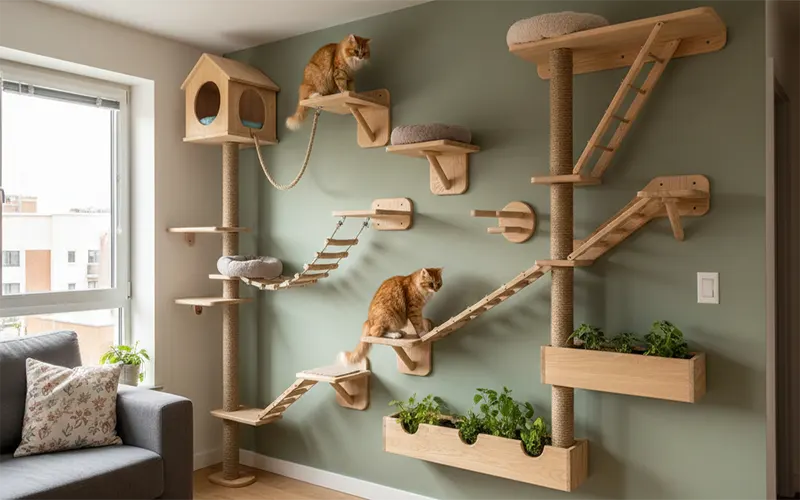
Before you pick up a drill, you must think like a cat. A single isolated shelf is a “dead end.” A “Cat Superhighway” is a continuous circuit that allows a cat to travel across a room without touching the floor.
The “Cat’s Eye View” Principle
Map out your route on the wall using painter’s tape first. Ensure there are no “traps”—places where one cat can corner another with no way down. Every highway should have at least two entrance/exit points.
Weight and Stability
A 10lb cat jumping from a distance exerts significant force.
- Find the Studs: Always aim to anchor your brackets into wooden wall studs using a stud finder.
- Heavy Duty Anchors: If you must install into drywall, use “toggle bolts” or “snaptoggles.” Never use the cheap plastic plug anchors that come with most shelves.
Materials Breakdown
- Wood: 1-inch thick pine or high-grade plywood. Avoid particle board, as it can crumble under the stress of jumping.
- Grip: Bare wood is slippery. Use self-adhesive carpet tiles, sisal mats, or cork sheets to provide traction.
Top 3 DIY Vertical Shelving Concepts
1. The “Floating Steps” System
This is the simplest and most aesthetic DIY project. It involves using small, staggered shelves to create a staircase effect.
- Spacing: Place shelves roughly 10–12 inches apart vertically and 12–15 inches apart horizontally.
- The Build: Use standard 10-inch deep shelving boards cut into 12-inch lengths. Sand the edges round to prevent injury.
2. The “Integrated Scratch Post Highway”
This concept combines a vertical climb with a horizontal getaway.
- The Build: Purchase a 4×4 wooden post and wrap it tightly in 3/8-inch sisal rope. Mount this post vertically against the wall using heavy-duty L-brackets.
- The Connection: Have the top of the post lead directly onto a long wall shelf. This mimics a tree-climbing experience.
3. The “Window Perch Observation Deck”
Windows are “Cat TV.” A dedicated shelf here is the ultimate enrichment.
- The Build: Create a deeper shelf (14–16 inches) to allow for lounging. Support it with reinforced brackets.
- Pro Tip: Line this shelf with a faux-fur bed or a self-warming mat to encourage long-term napping.
DIY Installation Guide: The Basic Floating Shelf
If you are new to DIY, start with this basic setup.
Tools Required
- Drill and bits
- Stud finder
- Bubble level
- Measuring tape
- Pencil
Steps
- Locate Studs: Use your stud finder to mark the vertical wood beams behind your drywall.
- Mark Height: Hold your bracket against the wall and mark the holes with a pencil. Use your level to ensure the marks are straight.
- Pre-Drill: Drill “pilot holes” into the studs. This prevents the wood from splitting.
- Attach Brackets: Screw your L-brackets into the wall.
- Secure the Shelf: Place your wood board on top and screw it into the brackets from underneath. Safety Check: Apply 20 lbs of downward pressure with your hands to ensure it doesn’t budge.
Safety & Enrichment Considerations
Landing Zones
A cat should never have to “aim” for a shelf that is too narrow. A shelf should be at least 10–12 inches deep. For lounging areas, aim for 14–18 inches.
Non-Slip Surfaces
This is the most common DIY fail. A cat that slips once may never use the shelving again.
- Solution: Use a staple gun or heavy-duty spray adhesive to attach carpet remnants to the top of every shelf.
Enrichment Add-ons
Make the highway a destination.
- Food Puzzles: Secure a plastic food puzzle to a wide shelf to encourage “foraging” at height.
- Hanging Toys: Drill a small eye-hook into the bottom of a high shelf and hang a feather toy (ensure the string is short enough to avoid entanglement).
Addressing Multi-Cat Dynamics
In a small apartment with multiple cats, “traffic jams” cause fights.
- Avoid “Dead Ends”: If a dominant cat sits in the middle of a single-path highway, the submissive cat is trapped.
- The “Peaceful Perch”: Create a shelf that is high up but tucked away, allowing a stressed cat to observe the room without being in the “line of fire” of high-traffic areas.
DIY cat shelving is more than just a home improvement project; it is an investment in your cat’s mental health. By thinking vertically, you transform a cramped apartment into a multi-level playground that satisfies your cat’s primal urges to climb, hunt, and survey. Grab your drill and a stud finder—your cat’s “superhighway” is waiting to be built.