
The Multi-Cat Challenge: Why Most Boxes Fail
When you have multiple cats, the “scooping fatigue” is real. Statistically, three cats will use a litter box roughly 9 to 15 times a day. For an automated system, this means the motor must cycle dozens of times without jamming, and the waste drawer must be large enough that you aren’t emptying it every 24 hours.
Standard automated boxes often fail in multi-cat environments due to:
- Small Waste Drawers: If the bin is full by noon, the machine stops cycling, leaving a mess for the next cat.
- Sensor Deadlock: In busy homes, one cat might jump in while the box is still cycling for another. Cheap infrared sensors can fail, leading to safety risks or mechanical jams.
- Rapid Odor Buildup: More waste means more ammonia. A multi-cat box requires superior sealing or active neutralization to keep your home from smelling like a kennel.
Top 3 Contenders Deep-Dive
1. The Gold Standard: Litter-Robot 4
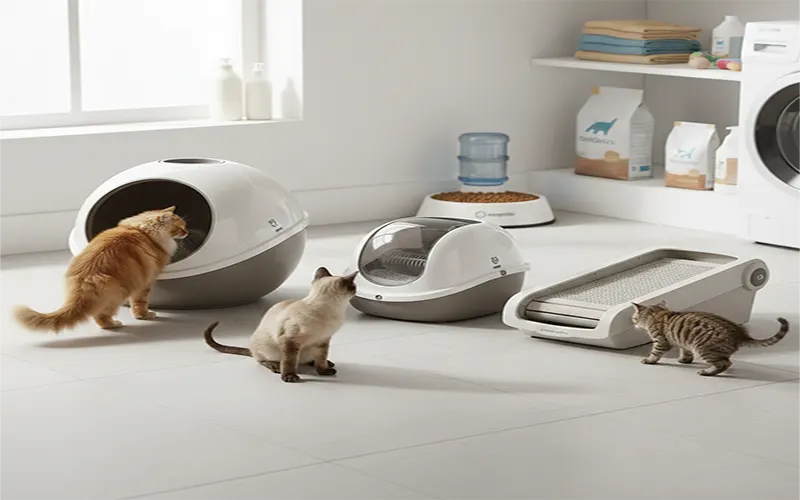
The Litter-Robot 4 (LR4) by Whisker is widely considered the “Tesla” of litter boxes. Unlike rake systems, the LR4 uses a rotating globe to sift waste.
- Key Multi-Cat Feature: The SmartScale technology. In a multi-cat home, it is often impossible to know which cat is experiencing a urinary issue. The LR4 weighs each cat as they enter and logs it in an app, allowing you to track individual health data.
- Safety: The OmniSense system creates a “curtain” of laser sensors at the entrance, ensuring the globe stops instantly if a second cat tries to investigate the moving machine.
- Pros: Quietest operation on the market; uses any standard clumping litter; massive waste drawer.
- Cons: Extremely high upfront cost ($700+); large footprint requires significant floor space.
2. The Budget-Conscious Alternative: PuraMax by Petkit
The PuraMax is a sleek, drum-style rotator that competes directly with the Litter-Robot but at a slightly lower price point.
- Key Multi-Cat Feature: The xSecure system. It utilizes thermal, infrared, and weight sensors to ensure total safety. It also includes an integrated “Pura Air” spray that automatically mists a deodorizer after every use.
- Design: It has a lower entry height than the Litter-Robot, making it a better choice for senior cats with mobility issues.
- Pros: Excellent app integration; very effective at sealing odors; modern aesthetic.
- Cons: The “cylinder” shape can be a bit cramped for very large breeds (like Maine Coons); requires proprietary deodorizer refills.
3. The Low-Maintenance Choice: PetSafe ScoopFree Crystal Pro
This is a rake-based system that uses crystal litter rather than clay. It doesn’t rotate; instead, a metal rake pushes solid waste into a hidden compartment.
- Key Multi-Cat Feature: “Set it and forget it.” Because the waste is dehydrated by the crystals, there is no rotating globe to get stuck.
- Pros: No “clumps” to stick to the ceiling of a globe; very easy to swap trays (takes 30 seconds).
- Cons: The scent of urine can build up faster in crystals in a multi-cat home; High proprietary cost for replacement trays.
Side-by-Side Comparison Table
| Feature | Litter-Robot 4 | Petkit PuraMax | PetSafe ScoopFree |
| Entry Height | 12 inches | 7.8 inches | 6 inches |
| Waste Capacity | High (Up to 2 weeks for 1 cat) | Medium-High | Low (7-10 days for 1 cat) |
| Sensor Type | Laser (OmniSense) | Thermal/Infrared | Infrared Beam |
| Individual Cat Tracking | Yes (By Weight) | Yes (By Weight) | No |
| Multi-Cat Rating | 9.5/10 | 8.5/10 | 6.5/10 |
The “Hidden Costs” of Automation
Before clicking “buy,” you must factor in the long-term operational expenses.
- Proprietary Trays/Bags: While the Litter-Robot allows you to use standard kitchen trash bags, the PetSafe ScoopFree requires proprietary cardboard trays that cost roughly $20–$25 each. In a three-cat home, you might go through three trays a month.
- Specialized Litter: The PuraMax and Litter-Robot require high-quality hard-clumping clay litter. If you use cheap, soft-clumping litter, it will smear against the globe during rotation, creating a nightmare to clean.
- Electricity: While these units use minimal power, they do run 24/7. Expect a negligible but permanent $1–$2 increase in your monthly utility bill.
Critical Safety Warning
Automated litter boxes are NOT for kittens. Most manufacturers specify that cats must weigh at least 3 lbs (usually around 6 months old) to use these machines.
The reason is simple physics: safety sensors are calibrated to detect weight or heat. A tiny kitten may not be heavy enough to trigger the sensor that stops a rotating globe or a moving rake. This can lead to the kitten being trapped or injured. If you have a multi-generational household, you must keep the automated box “off” or unplugged until the youngest member is large enough to be detected.
Maintenance Reality Check
A “self-cleaning” box does not mean a “never-clean” box. In a multi-cat household, the machine is working overtime.
- Weekly: Check the waste drawer and wipe down the “entry” sensors with a dry cloth.
- Monthly: Deep-clean the globe. For the Litter-Robot and PuraMax, this involves removing the drum, hosing it out with mild soap, and letting it dry completely before refilling with litter.
- The “Stick” Factor: Even with the best litter, multiple cats mean higher moisture levels. You will occasionally need to use a scooper to dislodge a “stuck” clump from the internal liner.
Which One Should You Buy?
Choosing the right box depends on your specific household needs:
- The “Power User” Choice: If you have 3+ cats and the budget, the Litter-Robot 4 is the undisputed winner. Its ability to track individual cat weights and its massive waste capacity make it the most reliable for heavy usage.
- The “Small Space” Choice: If you live in an apartment, the Petkit PuraMax has a smaller footprint and the best built-in deodorizing system.
- The “Senior Cat” Choice: If your cats are older and struggle with jumping, the PetSafe ScoopFree has the lowest entry point, though you will pay more in the long run for trays.
Whichever you choose, the transition will change your life—and your cats will thank you for the consistently clean bed of litter.