
The Carnivorous Vacuum: Understanding Morphology
To feed an axolotl correctly, you must first understand how they eat. Axolotls are obligate carnivores, meaning their bodies are biologically designed to process animal protein and very little else. Unlike many other amphibians, axolotls have vestigial teeth—tiny, cone-like structures that are not meant for chewing or tearing meat. Instead, these teeth are used merely to grip prey.
Their primary method of ingestion is known as buccal force feeding, or “suction feeding.” When an axolotl senses movement (primarily through lateral line systems and smell), it snaps its mouth open suddenly. This creates a powerful vacuum that pulls the prey, along with a significant amount of water, into the oral cavity. Because they swallow their food whole, the size and texture of what you provide are critical to preventing choking or internal blockages.
The Gold Standard: Earthworms and Nightcrawlers
If there is a “superfood” in the axolotl hobby, it is the earthworm. Specifically, European Nightcrawlers and Canadian Nightcrawlers are considered the gold standard for staple diets.
The reason for this is the Calcium to Phosphorus (Ca:P) ratio. For healthy bone development and metabolic function, amphibians require a diet where calcium levels ideally meet or exceed phosphorus levels. Earthworms provide this balance naturally.
Preparation Tips:
- For Juveniles: Cut nightcrawlers into bite-sized pieces (roughly the width of the space between the axolotl’s eyes).
- The Blanching Method: Some axolotls find the “slime coat” of a worm bitter. Dipping the worm in boiling water for 2 seconds (then immediately into cold water) kills the worm and removes the bitter secretions, making it more palatable.
- Red Wigglers Warning: While nutritious, Red Wigglers (Eisenia fetida) release a pungent yellow toxin when stressed. Many axolotls will spit them out. If yours does, stick to Nightcrawlers.
Supplementary and Occasional Foods
While earthworms should make up 80–90% of the diet, variety can provide enrichment and fill nutritional gaps.
High-Quality Pellets
Pellets are an excellent backup. Look for Salmon Sinking Pellets or specialized axolotl pellets. A good pellet should be high in protein (above 40%) and low in “fillers” like corn or wheat. They must be “soft-sinkers,” as hard, buoyant pellets can cause the axolotl to gulp air at the surface, leading to bloating.
Frozen Treats (The “Junk Food”)
- Bloodworms: These are the “candy” of the axolotl world. They are high in iron and protein but lack essential minerals for long-term health. Use them only for hatchlings or as an occasional treat for adults.
- Brine Shrimp: Excellent for young axolotls due to their vitamin content, but too small for adults to hunt efficiently.
Live Feeders: Risks and Rewards
Never feed goldfish or rosy red minnows. These fish contain thiaminase, an enzyme that blocks the absorption of Vitamin B1, leading to neurological failure. They also carry high parasitic loads. If you want to offer live prey for enrichment, Ghost Shrimp are the safest choice. They are low in fat, provide a calcium boost through their shells, and generally do not carry diseases that affect amphibians.
Feeding by Life Stage
| Life Stage | Recommended Food | Frequency | Feeding Method |
| Hatchling (< 2″) | Live baby brine shrimp, daphnia | Twice daily | Scattered in water |
| Juvenile (2–5″) | Chopped earthworms, bloodworms, small pellets | Once daily | Tongs or bowl feeding |
| Adult (> 6″) | Whole nightcrawlers, sinking pellets | Every 2–3 days | Tongs (targeted feeding) |
Nutritional Deficiencies and Hazards
The most common nutritional issue in axolotls isn’t just what they eat, but where they eat it.
The Danger of Impaction
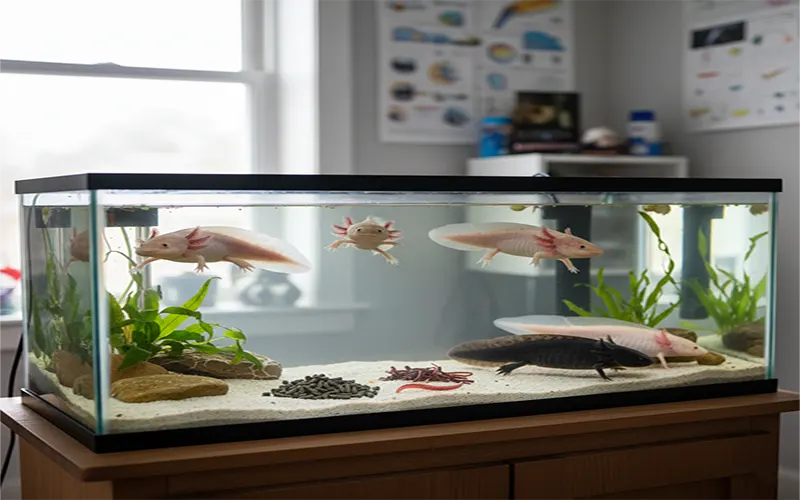
Because of their vacuum-like feeding style, axolotls will inhale anything near their prey. Gravel is the leading cause of death in captive axolotls. If a pebble is swallowed, it can become lodged in the intestines (impaction), leading to a slow and painful death. Always use fine aquarium sand or a bare-bottom tank.
Identifying Healthy Weight
A healthy axolotl should have a body that is roughly the same width as its head. If the body is significantly wider, the animal is obese (common with overfeeding pellets). If the body is thinner than the head, the axolotl is likely malnourished or suffering from a parasitic infection.
Vitamin B1 Deficiency
Symptoms include lethargy, loss of equilibrium, and “star-gazing” (tilting the head back fixedly). This is almost always caused by a diet of poor-quality feeder fish. Switching to a staple diet of earthworms usually resolves early-stage deficiencies.
The “Messy Eater” Factor: Water Chemistry
Axolotls are high-bioload animals. Their waste—and any uneaten food—breaks down into ammonia, which is toxic to their sensitive skin and gills.
High-protein foods like bloodworms or pellets break down rapidly. If a pellet is left in the tank for more than an hour, it can cause an ammonia spike that burns the axolotl’s gills. Spot-cleaning is mandatory. Use a turkey baster to remove uneaten food immediately after the axolotl has finished its meal. This practice is the difference between a thriving pet and one that suffers from chronic fungal infections.
Troubleshooting: Why Won’t My Axolotl Eat?
If your axolotl refuses food, check these three things in order:
- Temperature: If the water is above 20°C (68°F), their metabolism stresses out and they stop eating.
- Water Parameters: High nitrates (above 20ppm) cause nausea in amphibians.
- Stress: High water flow from a filter can make an axolotl feel “hunted,” causing them to refuse even their favorite worm.
Feeding a captive-bred axolotl is a lesson in simplicity and quality. By centering their diet around the humble earthworm and maintaining a pristine environment, you satisfy their biological requirements and their “vacuum” instincts. A well-fed axolotl is a long-lived one, capable of gracing your aquarium with its alien beauty for over a decade.